“This is a joyful thing”: a masterwork of Gija cultural knowledge
Gija Goowoolem doo Minybernem – Gija Trees and Grasses, by Birrmarriya Shirley Purdie and Frances Kofod
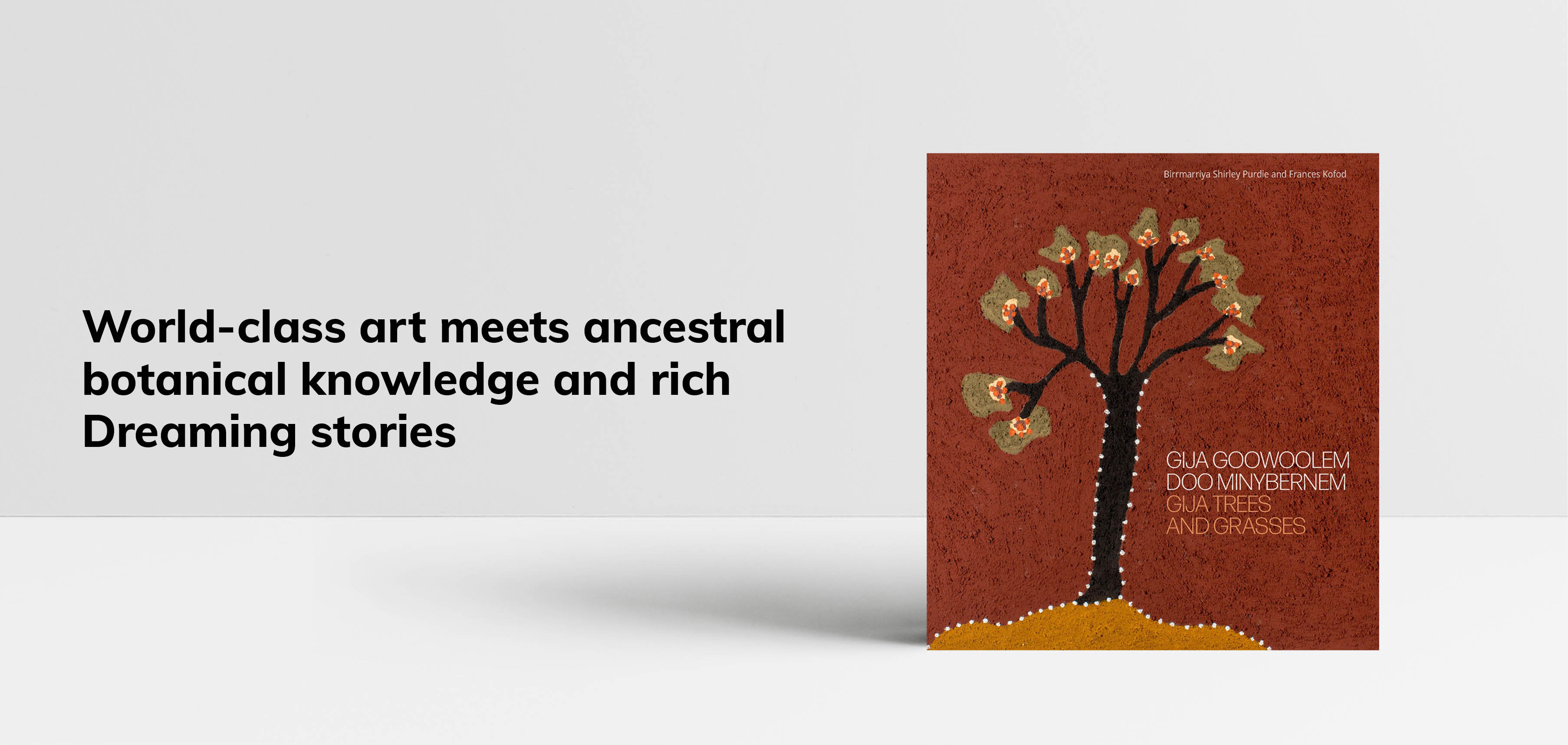
As more Australians embrace a renewed relationship with land – from tree‑changers to weekend bushwalkers – Gija Trees and Grasses meets that yearning with depth and generosity. This major new work by senior Gija artist and cultural leader Birrmarriya Shirley Purdie, created in collaboration with linguist, artist and gardener Frances Kofod, guides readers into the plants, language and cultural knowledge that have long sustained Gija people and Country.
The book has already earned high praise from cultural leaders, knowledge holders and field experts. Professor John Carty, Professor of Museum and Curatorial Studies at Adelaide University, describes the work as, “a joyful thing … a lifelong endeavour translated here into a rich and intimate book,” adding that Purdie’s paintings and stories, “flower across the pages like a love letter to Purdie’s Country”.
At its heart, Gija Trees and Grasses is a profound act of cultural continuity. Purdie’s intricate cataloguing of Gija flora began as a means of teaching her family and community, “so they will know about the trees and grasses and everything”. Throughout the book, Gija language holds prime place, reflecting her intention: “I made them to remind everyone after I have left them”.
A substantial hardcover volume, the book features 72 paintings, now in the collection of the Museum of Contemporary Art, Sydney, with text in Gija and English, stories and a parallel scientific guide containing botanical descriptions and Gija plant names. The text also details the traditional properties and uses of plants, including food, medicine and object‑making techniques, revealing the deep practical knowledge embedded in Gija Country. Audio recordings by Purdie in Gija provide access to aural history for Traditional Owners and future generations. These recordings are available on the MCA’s website.
The project was made possible through the support of the Gelganyem Group, who represent the Traditional Owners in the East Kimberley. Gelganyem’s work includes integrating traditional ecological knowledge into the rehabilitation of the Argyle diamond mine. Their support underscores the authority and cultural leadership Purdie already brings to this publication.
This book offers a rare opportunity to see Country through the knowledge and artistry of a respected Gija cultural leader. It’s a thoughtful gift for anyone embracing a tree change, for plant enthusiasts looking to bring more native species into their garden, or for readers seeking a deeper connection to the stories held in the land.
Published by Aboriginal Studies Press, Gija Trees and Grasses will be released on 1 April 2026. Find it at all good bookstores and through the AIATSIS Shop.
Release date: 1 April 2026
Publisher: Aboriginal Studies Press
RRP: $59.95 | 240pp | Hardcover
Preorder: shop.aiatsis.gov.au
- END -
Media assets available here:
- Information sheet with key details about Gija Trees and Grasses.
- Book cover image and select page spreads.
- Author pics.
- Map of Gija Country.
Attributable quotes
Glenn Wightman, NT Herbarium:
Gija Goowoolem doo Minybernem – Gija Trees and Grasses is a wonderful book brimming with deep Gija plant culture and beautiful imagery … Grab it quick, or it will be gone, like a ripe Minyjaarrany, the black plum fruit.
W Rodger Elliot AM, co-author of the Encyclopedia of Australian Plants:
This is a beautiful and important publication for many reasons … The accumulation of such knowledge by community elder Birrmarriya Shirley Purdie is very revealing regarding the Gija trees and grasses of the East Kimberley in northern Western Australia and their importance to her extended family and local people … May it be enjoyed and treasured by many, many people such as ecologists, botanists, plant lovers and enthusiasts.
Associate Professor Joe Blythe, Macquarie University:
To describe Gija Trees and Grasses as unique would be an understatement. It defies categorisation, and I would be hard pressed to decide which is the more important: its role as an encyclopedia of plant uses or as a catalogue of an extraordinary set of contemporary paintings. Shirley’s extraordinary knowledge about bush foods and medicines, and the culturally important plants that have sustained Gija people for generations, has made this work of love for Country an essential account, whose cultural value to Shirley’s people and descendants will last a long time.
Media enquiries
Aboriginal Studies Press
Email media enquiries to asp@aiatsis.gov.au
+61 2 6129 3934
9 am to 5 pm, Monday to Friday
Website: Aboriginal Studies Press
Facebook: @aiatsis
Instagram: @aiatsis
About the authors
Birrmarriya Shirley Purdie is a Gija woman of Nangari skin who was born in 1947 at Gilban (Mabel Downs Station) in the East Kimblerley region of Western Australia. As a respected community Elder and as part of her cultural responsibilities, Birrmarriya passes on her encyclopaedic knowledge of Gija language, cultural practices, the intrinsic ecological relationships of Country, ethnobotanics and flora and fauna identification with family, schools, seed collectors, scientists, environmentalists, miners, pastoralists and ranger groups. Birrmarriya has been painting since the early 1990s. She was awarded the Blake Prize for Religious Art in 2007, and her work is held in major national collections, including at the Museum of Contemporary Art and the National Portrait Gallery.
Frances Kofod was born in Sydney in 1948 and grew up there and in Armidale in northern New South Wales. In 1978, she completed her Master of Arts thesis on the Miriwoong language. Frances first met Birrmarrya Shirley Purdie in 1987, when working as a linguist in the Gija language program at Ngalangangpum School at Warrmarn. Frances’s first recordings of Birrmarriya relating the stories of her paintings date from this time. From the late 1980s to the present, Frances continues to work on many language projects involving Miriwoong, Gija and Gajirrabeng languages and was the main compiler of the Gija Dictionary (Aboriginal Studies Press, 2022).